Stock photography research

Title

What’s Behind Those “Happy Diversity” Smiles? A Social Semiotic Analysis of Representations of “Diversity” In Stock Photography

Purpose

Examining the common photography practices for depicting “diversity” in organizational and diversity management contexts

Description

Researchers have identified patterns in the “diversity rhetoric” organizations use to discuss the importance of diversity. While similarly criticized, there has been less critical attention to the photographs used to illustrate support. This critical social semiotic analysis draws on Critical Race Semiotics, visual rhetoric, and past examinations of stock photography to examine popular representations of “diversity” in stock photography to demonstrate how they support problematic ideologies, practices, and expectations. It concludes with recommendations for application in the doing and teaching of public relations.

Research type

Mixed methods research, visual analysis, content analysis, semiotics

Research format

Presented as a poster at the University of Oregon’s Graduate Student Research Forum (May 10, 2024)

References

  1. Ahmed, S. (2012). On being included: Racism and diversity in institutional life. Duke University Press.
  2. Aiello, G., Thurlow, C., & Portmann, L. (2023). Desocializing social media: The visual and media ideologies of stock photography. Social Media + Society, 9(1), 1–14.
  3. Akinola, M. (2016). Diversity isn’t what it used to be: The consequences of broad diversity definitions [Speech]. 2016 Gender & Work Symposium: Talking the Walk, Harvard Business School.
  4. Benschop, Y., & Meihuizen, H. E. (2002). Representations of gender in financial and social annual reports. In I. Aaltio-Marjosola & A. J. Mills (Eds.), Gender, identity, and the culture of organizations (pp. 160–184). Routledge.
  5. Biswas, M., & Bland, D. (2024). Diversity, equity, and inclusion strategies: Learning from journalism and mass communication programs with professional impact. Rowman & Littlefield.
  6. Edelman, L. B., Fuller, S. R., & Mara‐Drita, I. (2001). Diversity rhetoric and the managerialization of law. American Journal of Sociology, 106(6), 1589–1641.
  7. Ernst, E. R. (2016). The price of progressive politics: The welfare rights movement in an era of colorblind racism. New York University Press.
  8. Gatrell, C., & Swan, E. (2008). Gender and diversity in management: A concise introduction. SAGE.
  9. Georgeac, O. A. M., & Rattan, A. (2023). The business case for diversity backfires: Detrimental effects of organizations’ instrumental diversity rhetoric for underrepresented group members’ sense of belonging. Journal of Personality and Social Psychology, 124(1), 69–108.
  10. Henry, A. (2024). Collaborators for change: Research on the relationship between communications and diversity executives. Institute for Public Relations.
  11. Kress, G. R., & van Leeuwen, T. (2021). Reading images: The grammar of visual design (Third edition). Routledge.
  12. Kvåle, G. (2023). Critical literacy and digital stock images: The interests of the uninteresting images. Nordic Journal of Digital Literacy, 18(3), 173–185.
  13. Lawrence, S., & Hylton, K. (2022). Critical race theory, methodology, and semiotics: The analytical utility of a “race” conscious approach for visual qualitative research. Cultural Studies ↔ Critical Methodologies, 22(3), 255–265.
  14. Logan, N., Place, K. R., Fussell Sisco, H., Vasquez, R., George, A., Terdik, M., & Rai, R. (2023). Diversity, equity, and inclusion in public relations: Moving beyond the status quo. In E. L. Toth & P. G. Bourland-Davis (Eds.), Navigating change: Recommendations for advancing undergraduate public relations education (pp. 82–93). Commission on Public Relations Education.
  15. Machin, D. (2004). Building the world’s visual language: The increasing global importance of image banks in corporate media. Visual Communication, 3(3), 316–336.
  16. Machin, D., & van Leeuwen, T. (2007). Global media discourse: A critical introduction. Routledge.
  17. Liu, H. (2021). Diversity beyond whiteness: The possibilities for anti-racist diversity research. In S. Nørholm Just, A. Risberg, & F. Villesèche (Eds.), Routledge companion to organizational diversity research methods (pp. 24–35). Routledge, Taylor & Francis Group.
  18. Liu, H., & Pechenkina, E. (2016). Staying quiet or rocking the boat? An autoethnography of organisational visual white supremacy. Equality, Diversity and Inclusion: An International Journal, 35(3), 186–204.
  19. Logan, N., Place, K. R., Fussell Sisco, H., Vasquez, R., George, A., Terdik, M., & Rai, R. (2023). Diversity, equity, and inclusion in public relations: Moving beyond the status quo. In E. L. Toth & P. G. Bourland-Davis (Eds.), Navigating change: Recommendations for advancing undergraduate public relations education (pp. 82–93). Commission on Public Relations Education.
  20. Machin, D. (2004). Building the world’s visual language: The increasing global importance of image banks in corporate media. Visual Communication, 3(3), 316–336.
  21. Swan, E. (2010). Commodity diversity: Smiling faces as a strategy of containment. Organization, 17(1), 77–100.
  22. Thomas, K. D., Johnson, G. D., & Grier, S. A. (2023). Perspectives: Race and advertising: Conceptualizing a way forward through aesthetics. International Journal of Advertising, 42(3), 617–637.
  23. Thurlow, C., Aiello, G., & Portmann, L. (2020). Visualizing teens and technology: A social semiotic analysis of stock photography and news media imagery. New Media & Society, 22(3), 528–549.
  24. Machin, D., & van Leeuwen, T. (2007). Global media discourse: A critical introduction. Routledge.
  25. Voisin, K. (2023, July 5). Trending image searches on Shutterstock 2023. Shutterstock.
  26. Wilton, L. S., Bell, A. N., Vahradyan, M., & Kaiser, C. R. (2020). Show don’t tell: Diversity dishonesty harms racial/ethnic minorities at work. Personality and Social Psychology Bulletin, 46(8), 1171–1185.
  27. Zheng, L. (2023). DEI deconstructed: Your no-nonsense guide to doing the work and doing it right (First edition). BK Berrett-Koehler Publishers, Inc.
  28. All images purchased from Shutterstock except photographer image by Allef Vinicius on Unsplash.

Business case research

Title

Demonstrating framing choices as “relevant and real”: A content analysis of the diversity rhetoric used by Fortune 500 companies

Purpose

Creating a case study to demonstrate the importance for communicators to understand the impact of the frames and messages they share

Description

Since the 1980s, companies have increasingly turned to broad definitions of diversity (Akinola, 2016, 2017; Edelman et al., 2001; Mease, 2016) along with rhetoric emphasizing the direct and indirect companies gain from diversity (Georgeac & Rattan, 2023; Gutierrez & Kellar, 2023; Pasztor, 2019).

There are considerable concerns that this rhetoric “risks reducing people to resources, limits the possibilities for altering human interaction, and reinforces identity hierarchies” (Mease, 2012, p. 2). More recent research (Georgeac and Rattan, 2022) found that the use of business-centered rhetoric can have “detrimental consequences for the very applicants that companies seek to attract.”

This research is a quantitative content analysis examining the diversity case, definitions, and identities published by Fortune 500 companies to explain their diversity initiatives.

Type of Project

Quantitative research (currently), content analysis, secondary research

Research Status

Initial research was presented during a session at the Communicating Diversity Conference in Austin, Texas.

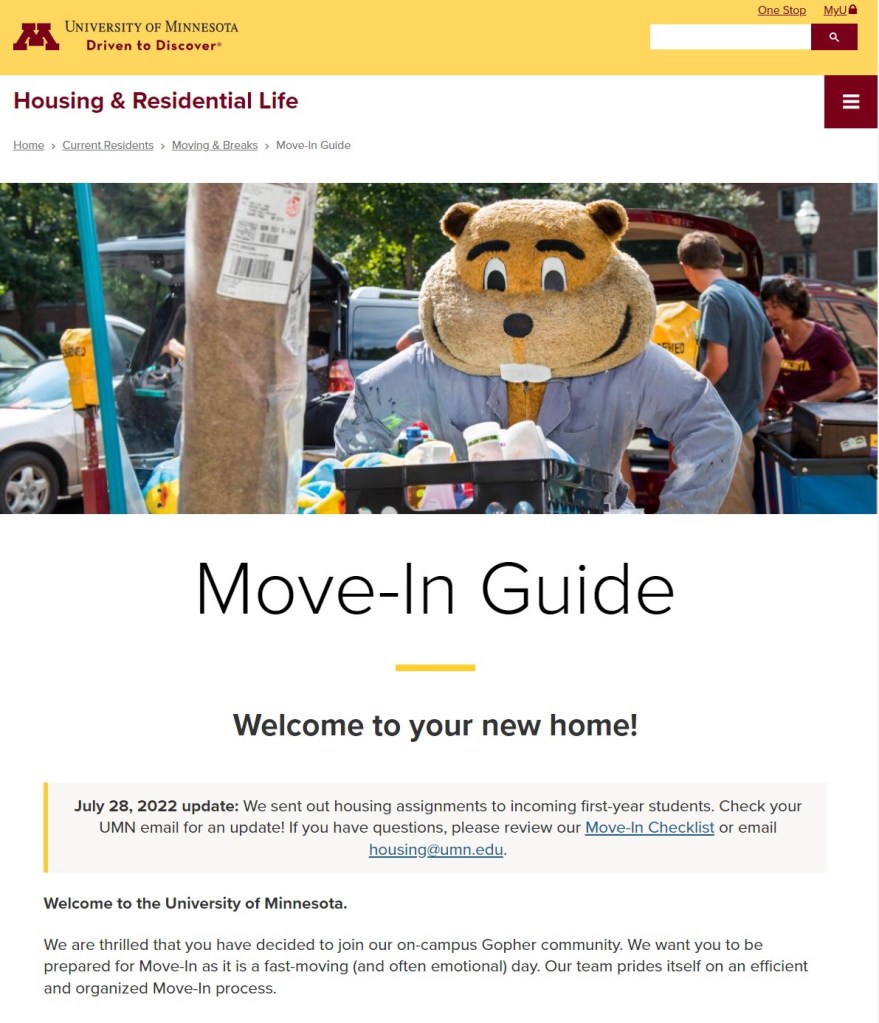
HRL Move-In Guide and Checklist

Organization

Housing & Residential Life (University of Minnesota)

Description

There’s a lot to do before move-in both for incoming residents and Housing & Residential Life. For many years, Housing & Residential Life printed a large Move-In Guide that was sent to all incoming residents with their housing assignments. Before I arrived at the department, the information was migrated to the website to save on printing.

While useful from a fiscal standpoint, the information was spread across various pages/sections of the website. This made it difficult for incoming residents and HRL staff to find the information they needed, and it also meant there was no easy way for them to discover steps they were unaware of.

I significantly revised this website section, focusing on the needs of incoming students while also addressing items HRL needed to publicize. In particular, I added a comprehensive Move-In Checklist that contained quick answers to the questions most frequently asked by students/families, along with links to additional information elsewhere on the website. This helped incoming residents and staff by providing them with one place to go for the information.

Type of Project

  • Writing
  • Information Design
  • Website Content

Supporting International Students

Access the Document (Google Drive Link)

Organization

Immigration Response Team (University of Minnesota)

Description

International students were facing extreme challenges before the start of the fall 2021 semester. While they were determined to come, schools needed to take action to make connections across campus and with community members/local officials to help make their arrival smooth.

Due to the expertise and experience of the Immigration Response Team, we were asked to create a handout with our recommendations to share with other schools. It needed to be understandable both for administrators/staff who were familiar with immigration/international student concerns and those who were not.

I was provided a long bulleted list of potential items to include. Upon reviewing the list, I decided to organize the document to include 1) Items to consider, 2) Talking points, and 3) Actions to take.

Type of Project

  • Writing
  • Document design

Immigration Response Team Email

Read a sample message (Google Drive link)

Organization

UMN Immigration Response Team

Description

I regularly write messages that must combine factual updates (including complex items) with an empathetic and caring tone. When developing these messages, I focus on the needs of the reader and a wish to recognize those most impacted by the information (for example, immigrant and international students).

Type of Project

  • Writing
  • Email Communications
  • Message Development

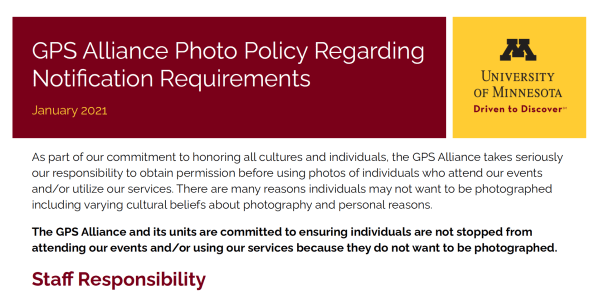
GPS/ISSS Photography Policy

Read the policy (Google Drive link)

Organization

International Student and Scholar Services and the Global Programs and Strategy Alliance (University of Minnesota)

Description

While many organizations have all clients sign photo waivers as a matter of practice, there are many reasons why individuals do not want to be photographed for publicity purposes. These reasons can range from bad hair days to suspicions that their photo will be misused or cultural beliefs. As part of the GPS’s commitment to respecting all cultures, I worked with leadership to create a policy requiring staff to create plans to 1) give people every opportunity possible to refuse to allow their photo to be taken and 2) ensure individuals aren’t prevented from using services/attending events solely due to not wanting their photo taken.

Additional Information

Type of Project

  • Equity concerns in communications
  • Organizational policy

BGA Editorial Calendar

View the calendar (Google Drive Link)

Organization

BlueGreen Alliance and BlueGreen Alliance Foundation

Description

Like many organizations, the BlueGreen Alliance had a variety of activities happening simultaneously, and many required support from the communications team. To streamline operations, I created the organization’s first comprehensive editorial calendar to track the message of the week, events, and the materials being made to support it.

Type of Project

  • Communications planning

COVID-19 Response

Read the summary (Google Doc Link)

Organization

International Student and Scholar Services (University of Minnesota)

Project Description

In addition to the concerns all students held due to COVID-19, international students had to respond to frequently changing immigration regulations, questions of whether to travel home, and fear due to increased instances of xenophobia and anti-Asian hate. To help, I coordinated an ongoing communications plan for ISSS that used dedicated web pages, emails, videos, and webinars to share information.

In addition to materials created for international students, this plan also included updates for UMN staff and departments about the need to communicate with international students.

Type of Project

  • Communications planning
  • Message development

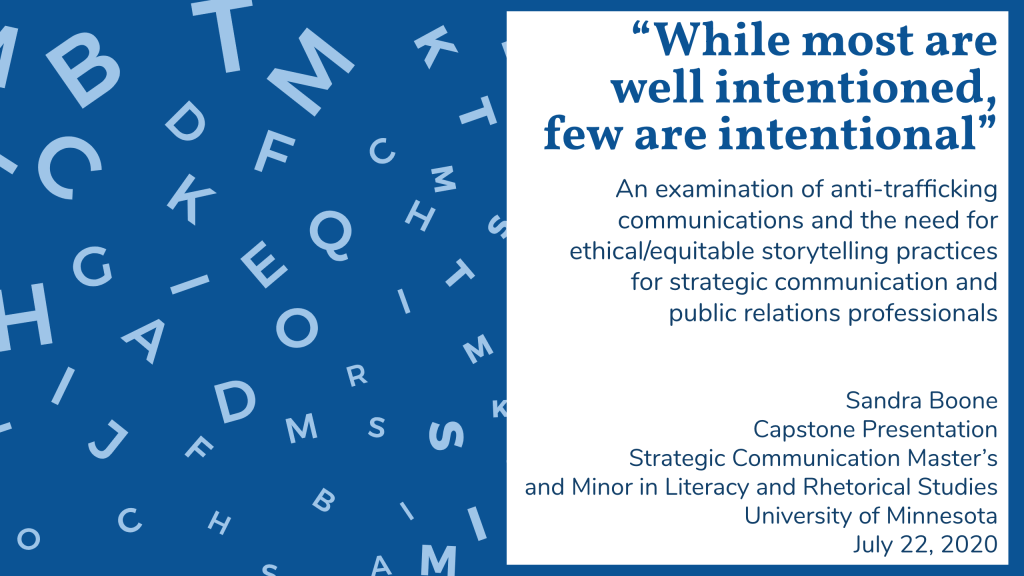
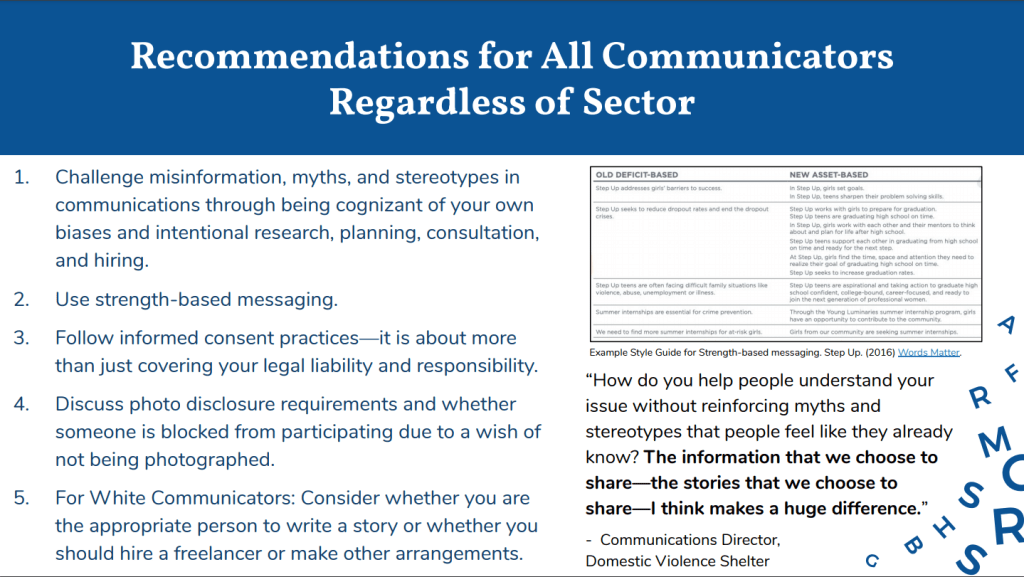
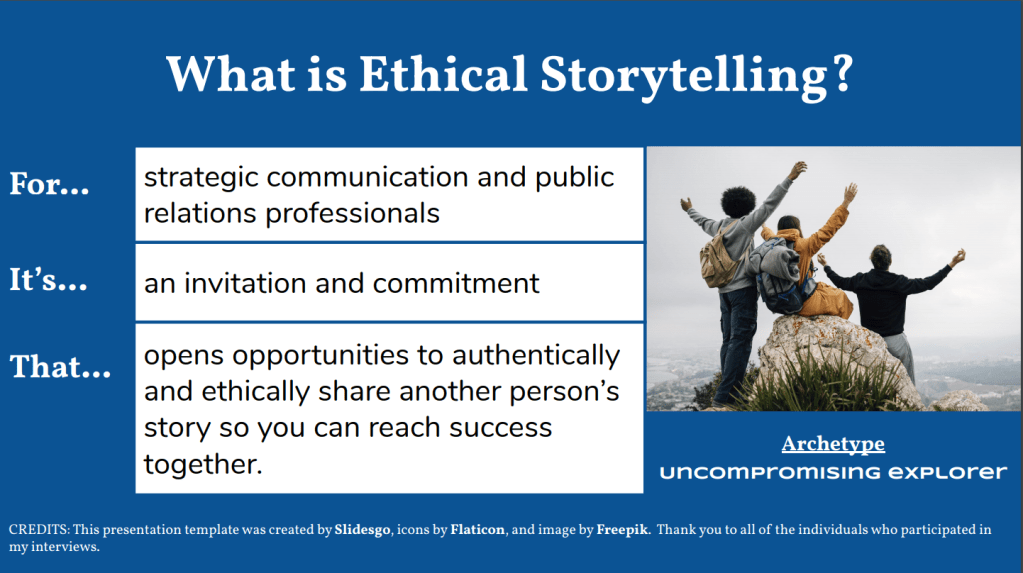
Ethical Storytelling Research

Purpose

Capstone Research for Strategic Communication MA and Literacy & Rhetorical Studies Minor

Description

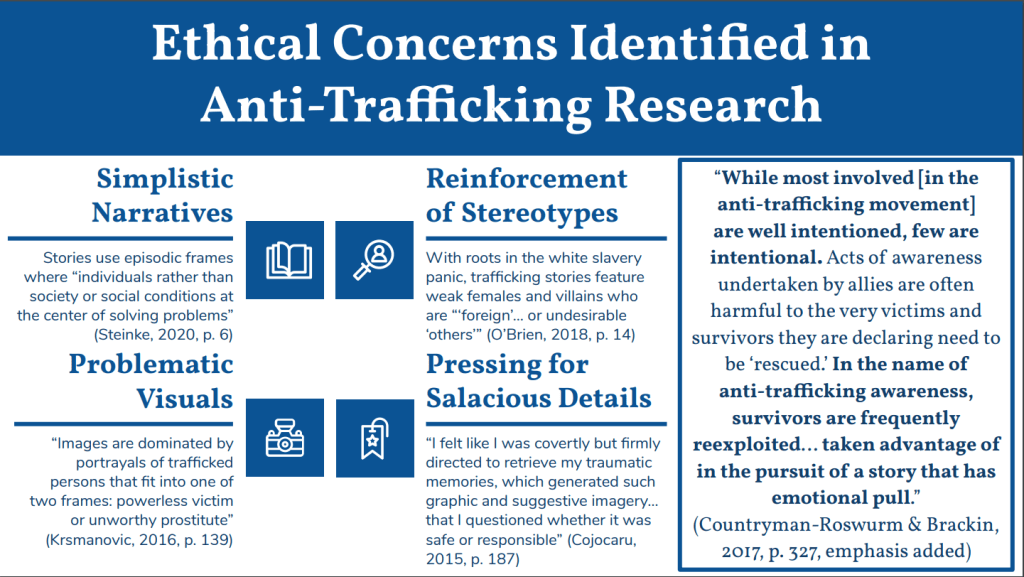
For my Strategic Communication MA Capstone, I examined the communications practices of anti-trafficking organizations as an avenue to discuss the need for ethical/equitable storytelling approaches I conducted 10 semi-structured interviews with communications professionals working in anti-trafficking and related organizations along with 8 additional subject-matter experts. I also reviewed strategic communication/public relations research and practitioner conversations for discussions of ethics, equity, and power.

In this work, I sought to bridge how communicators can balance their responsibility to create communications that fulfill organizational objects with a deeper responsibility to honor, respect, and consider the best interests of the individual(s) involved. I then recommended work practices for communicators working with victims of trauma and beyond.

Type of Project

Qualitative research, secondary research

Length of Time

4 months (April-July 2020)

Website Built with WordPress.com.

Up ↑